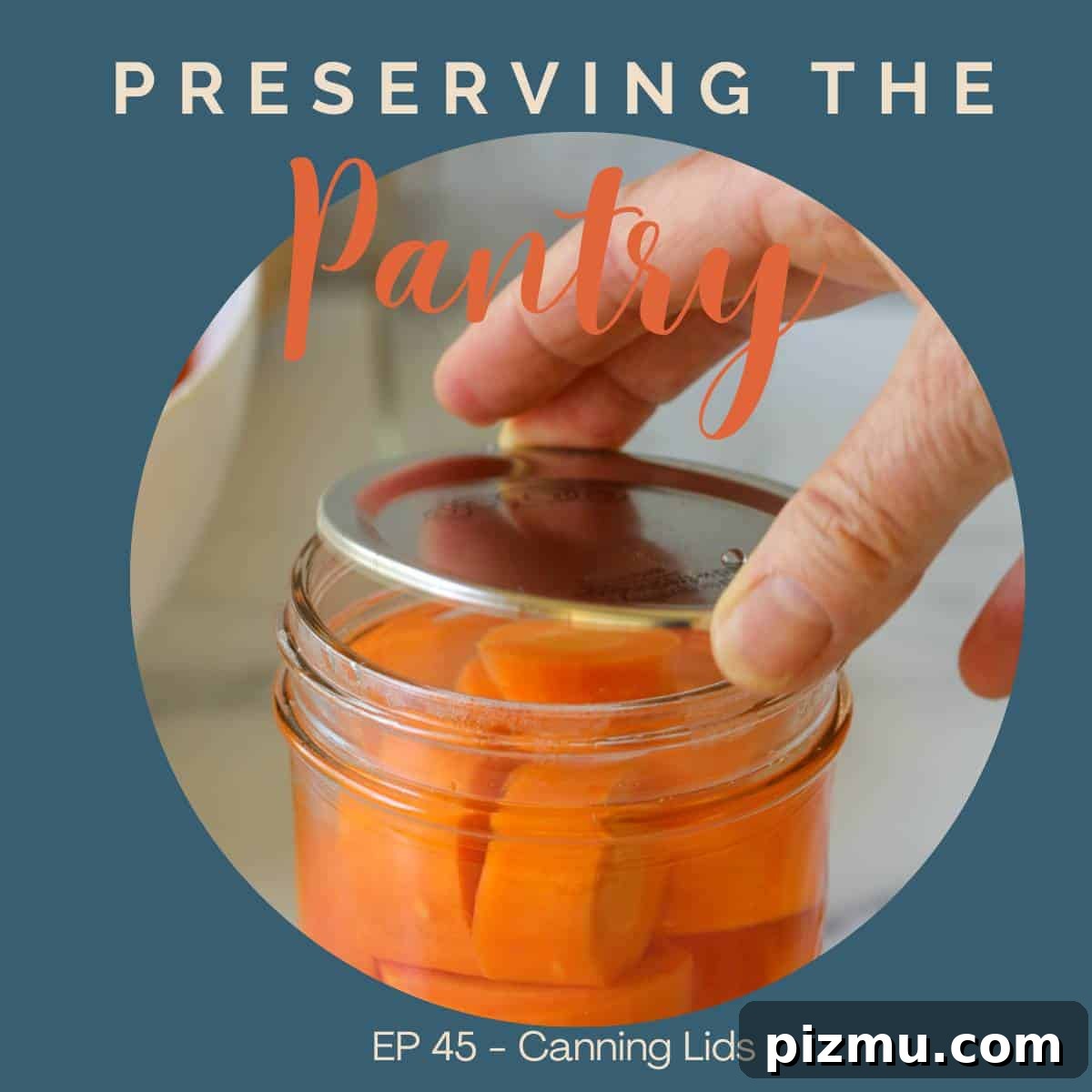
In this episode, Kathy explains everything you need to know about canning lids for both water bath and pressure canning. She covers which lids and rings to use, how they work, storage guidance, and best practices to ensure a reliable seal.
Play the episode
Listen to this episode on your preferred podcast platform or app to hear the full discussion.
Resources
Resources mentioned in this episode:
- Episode 44: Canning Jars
- Episode 43: Headspace in Canning
- Water Bath Canning (overview)
- Pressure Canning (overview)
- National Center for Home Food Preservation guidance
In this episode you’ll learn:
- Key information about lids used for home canning
- Which lid-and-ring system is recommended by the National Center for Home Food Preservation
- How long unused lids remain reliable
- Whether you should boil lids before canning
Where to listen to the podcast
Find this episode on your favorite podcast player or app. A written transcript follows below for quick reference.
If you enjoy the podcast, please leave a comment below and say hi on Instagram @preservingthepantry!
Transcript
Hello everyone, and welcome back to Preserving the Pantry. Today we continue our behind-the-scenes series on canning basics. These episodes aren’t recipe-focused; instead, they cover essential techniques and equipment you should know before you start preserving food.
Previously we discussed canning jars and proper headspace. Today our focus is on canning lids and screw bands—the two-piece system commonly used for home canning and recommended by the National Center for Home Food Preservation.
The two-piece system consists of a flat sealing lid with a sealing compound around its edge and a reusable ring that screws the lid onto the jar. This approach is widely accepted for home canning because it is straightforward, accessible, and makes it easy to verify a successful seal once jars cool.
Rings are reusable. You can use them repeatedly until they show signs of damage such as rust, deep dents, or severe warping—when that happens, discard them. The flat lids, however, are intended for one-time use only. After you open a jar and consume its contents, replace the flat lid with a new one for the next canning session.
Manufacturers and preservation authorities recommend buying only as many lids as you expect to use within a single canning season—typically about a year. Some people prefer to keep a small surplus in case they run out mid-season, which is fine, but try not to stockpile lids for many years. Lids stored for more than five years may be less likely to form a reliable seal, increasing the risk of jars failing to seal properly.
Here’s how sealing works in practice: fill jars according to your recipe and leave the correct headspace. Wipe rims clean to remove food particles, center a flat lid on each jar, and screw on the ring until it’s just fingertip-tight. Place jars in the water bath canner or the pressure canner and process according to the recipe’s time and pressure instructions.
As jars heat during processing, air is expelled and the sealing compound on the lid softens and conforms to the jar rim. Once processing is complete and jars cool, contents contract slightly and create a vacuum. That vacuum pulls the lid down, forming a tight seal that protects the food inside. After jars are completely cool, remove the rings, wash the jars if needed, and check for a proper seal.
In past decades, people often boiled lids before using them, but that practice is no longer recommended. Instead, simply wash lids in warm, soapy water, rinse well, and place them on the jars—no pre-boiling or soaking required. Avoid using lids that are dented, have a poorly attached sealing compound, or otherwise appear damaged straight out of the package.
To summarize: use the two-piece lid-and-ring system endorsed by preservation authorities; reuse rings until they are damaged; use flat lids only once and try to use them within a season or up to about five years; don’t boil lids before use—just clean them; and always inspect lids and rings for damage before canning. Following these simple steps helps ensure a reliable seal and safe preserved food.
Thanks for joining me. Get your supplies ready for canning season, and I’ll see you next week in the pantry. Be sure to tune in again for more episodes of Preserving the Pantry.